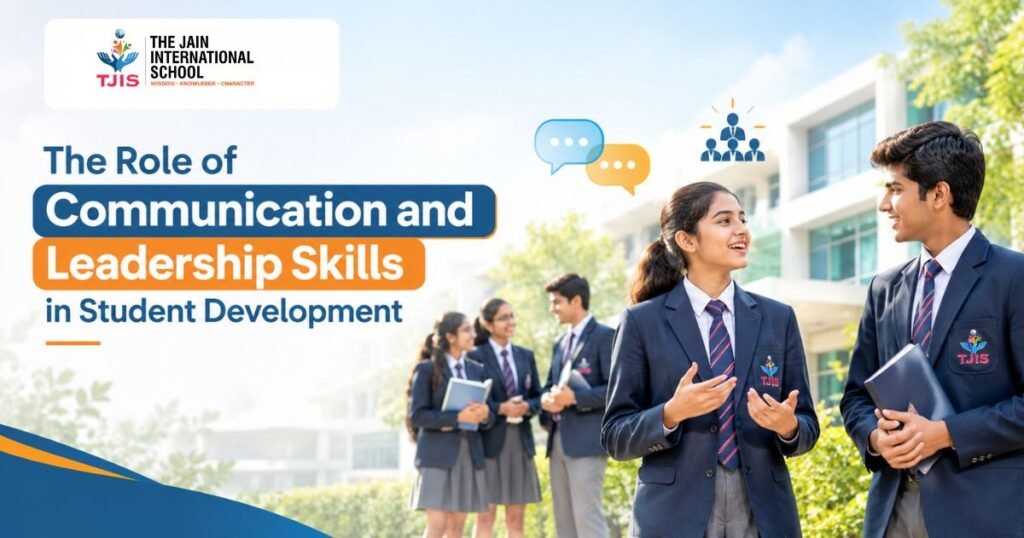
Education no longer limits itself to academic achievement. In today’s rapidly changing world, students need a combination of knowledge, confidence, creativity, collaboration, communication, and leadership skills to succeed in school and beyond. While strong academic foundations remain important, the ability to express ideas clearly, work with others, make responsible decisions, and take initiative plays an equally important role in overall student development.
Communication and Leadership Skills in Student Development help children become confident individuals who can handle challenges, participate actively, and contribute positively to their communities. Schools that provide opportunities for students to communicate, collaborate, and lead can help prepare them for higher education, careers, and everyday life.
At The Jain International School, students are encouraged to develop these essential life skills alongside academic learning through classroom activities, co-curricular programmes, group projects, sports, presentations, and leadership opportunities.
Why Communication Skills are Important for Students
Communication is one of the most important skills a student can develop. It enables children to express their thoughts, understand different perspectives, ask questions, and build meaningful relationships with teachers and classmates.
Effective communication includes much more than speaking confidently. Students also need to develop listening, reading, writing, presentation, and interpersonal skills. When children learn to communicate respectfully and clearly, they become more comfortable participating in discussions and sharing their ideas.
Good communication skills can help students:
- Express thoughts and opinions with clarity
- Develop confidence while speaking in front of others
- Listen and respond appropriately
- Participate effectively in group discussions
- Build positive relationships with peers and teachers
- Handle disagreements respectfully
- Improve presentation and public-speaking abilities
Classroom discussions, storytelling, debates, presentations, role plays, and group activities can give students practical opportunities to develop these abilities.
For parents exploring a school that focuses on both academics and holistic growth, learning more about TJIS and its educational approach can provide valuable insight into how students are encouraged to develop beyond textbooks.
Developing Leadership Skills Through School Activities
Leadership is not simply about holding a position or being in charge of others. True leadership involves responsibility, confidence, empathy, decision-making, teamwork, and the ability to motivate others.
Leadership Skills For Students can be developed gradually by giving children opportunities to take responsibility in age-appropriate situations. A student may lead a group project, coordinate an activity, participate in a school council, captain a sports team, or help classmates complete a task.
These experiences teach students how to:
- Take responsibility for their decisions
- Work towards common goals
- Organize tasks and manage time
- Solve problems independently
- Listen to different viewpoints
- Support and motivate team members
- Accept success and failure positively
School leadership opportunities can also help students understand that leadership is closely connected with service and responsibility. A good leader learns to listen, cooperate, and support others rather than simply giving instructions.
Parents interested in understanding how schools can combine academic learning with broader personal development can also explore TJIS School Activities to learn more about the wider learning environment.
How Communication and Leadership Work Together
Communication and leadership are closely connected. A student may have excellent ideas, but communicating those ideas effectively is essential for turning them into action. Similarly, a student who can communicate confidently but cannot listen, collaborate, or take responsibility may find leadership challenging.
Communication and Leadership Skills in Students develop together through practical experiences.
For example, consider a group project where students must create a presentation. One student may organize the team, another may research information, another may prepare visual content, while another presents the final project. To complete the task successfully, students must communicate clearly, listen to one another, divide responsibilities, resolve differences, and work towards a shared objective.
These experiences develop skills that cannot always be taught through traditional classroom instruction alone.
Leadership also encourages students to become better communicators. When students are given responsibility, they learn that their words, actions, and decisions can affect others. This encourages them to communicate thoughtfully and respectfully.
Schools can further strengthen these skills through debates, public speaking, cultural programmes, sports, student councils, community activities, competitions, and collaborative learning.
Preparing Students for A Future Beyond The Classroom
The importance of communication and leadership extends well beyond school life. Students will eventually enter environments where they need to work with people from different backgrounds, communicate ideas, solve problems, and adapt to new situations.
Employers and higher-education institutions increasingly value students who can demonstrate teamwork, initiative, creativity, adaptability, and effective communication. Developing these abilities from an early age gives children a stronger foundation for future opportunities.
Leadership experiences can also improve self-awareness. When students take responsibility for a task, they learn to recognise their strengths and areas for improvement. Facing challenges helps them develop resilience and a willingness to learn from mistakes.
Parents can support this development at home by encouraging children to express their opinions, listen carefully, make age-appropriate decisions, participate in household responsibilities, and learn from both achievements and setbacks.
At school, teachers can create an environment where every student receives opportunities to participate rather than limiting leadership opportunities to a small group of children.
Building Confident and Future-Ready Students
The development of communication and leadership skills is a continuous process. It begins with small opportunities to speak, listen, collaborate, make decisions, and accept responsibility. Over time, these experiences can help students become more confident, independent, and socially responsible individuals.
A strong educational environment should therefore look beyond marks and examinations. Holistic Student Development combines academic knowledge with practical skills that help children navigate real-world situations.
At TJIS, opportunities for classroom participation, co-curricular learning, teamwork, sports, student leadership, and other activities can contribute to the development of well-rounded learners. By creating opportunities for students to communicate their ideas and take responsibility, schools can help children discover their potential and develop the confidence to use it.
Conclusion
Communication and leadership skills are essential components of modern education. They help students express themselves confidently, work effectively with others, make responsible decisions, and approach challenges with greater confidence.
Are you looking for an educational environment that supports Academic Excellence, Communication Skills, Leadership Development, And Holistic Student Growth? Contact The Jain International School to learn more about our learning environment, programmes, and opportunities for student development.